

What Makes Whale Watching in Maui a Must-Do Experience?
Whale Watching in Maui

Quick Answer: Whale watching in Maui is a must-do experience because Maui's waters host the world's largest concentration of North Pacific humpback whales each winter (November–April), offering some of the most reliable, up-close encounters on the planet. Whether you choose a boat tour or maui kayak whale watching, you're virtually guaranteed to witness breaches, tail slaps, and mother-calf pairs in Hawaii's crystal-clear waters.
Whale watching in Maui stands apart from every other ocean destination because of a rare convergence of geography, biology, and water conditions. The four-island channel formed by Maui, Lanai, Molokai, and Kahoolawe creates a naturally protected basin of warm, shallow water that humpback whales seek out every winter to breed and give birth. Water depths here average just 300 feet, which means whales stay close to the surface and, by extension, close to you.
More than 10,000 North Pacific humpback whales make this migration annually. That sheer concentration means whale watching in Maui isn't a game of patience or luck it's practically a guarantee. In some cases, paddlers on kayak whale watching tours have had humpbacks surface within 50 yards of their boats, close enough to hear the whale exhale.
The Hawaiian Islands Humpback Whale National Marine Sanctuary, which encompasses Maui's prime waters, was established specifically because this region is so biologically critical. When you're out there on the water, you're not just a tourist you're a guest in one of the most important marine habitats on Earth.
The season officially runs November through May, but the sweet spot is January through March. During these months:
Humpback concentrations are at their annual peak
Newborn calves are highly active near the surface
Male whales are singing and competing for females, producing dramatic surface behaviors
Whale watching tours in Maui run multiple daily departures to meet demand
January is statistically the single best month. Visibility is excellent, trade winds are steady without being severe, and whale activity is near-constant throughout the day. That said, even early-season November trips consistently deliver sightings, so don't postpone if December is when your trip lands.
This is the decision most visitors wrestle with, and both experiences are genuinely extraordinary just in different ways.
Boat-Based Whale Watching Tours in Maui
The most popular format involves rigid-hull inflatable boats, catamarans, and snorkel-combo vessels departing from Maalaea Harbor or Lahaina. The advantages are significant: many vessels carry hydrophones that let you hear whale song underwater in real time, certified naturalists provide live marine biology commentary, and the elevated vantage point makes photography easier. Tours typically run 2–3 hours with multiple daily departures. These are ideal for families, first-timers, and anyone who wants structured education alongside the spectacle.
Maui Kayak Whale Watching — The Most Intimate Option
If proximity and silence are what you're after, maui kayak whale watching operates in a category of its own. Small groups of paddlers launch from South Maui beaches Makena and Kihei are the most common departure points and paddle into open water where whales are actively feeding and resting.
The silence of a kayak is what makes kayak whale watching so viscerally different. There's no engine noise. You're sitting inches above the waterline. When a 40-ton humpback surfaces 60 yards away, the sound of its exhale hits you physically a low, resonant whoosh you feel before you process it. No photograph captures it. Responsible operators follow NOAA's 100-yard approach guidelines and keep groups small, typically 6–8 paddlers, which protects both participants and whales.
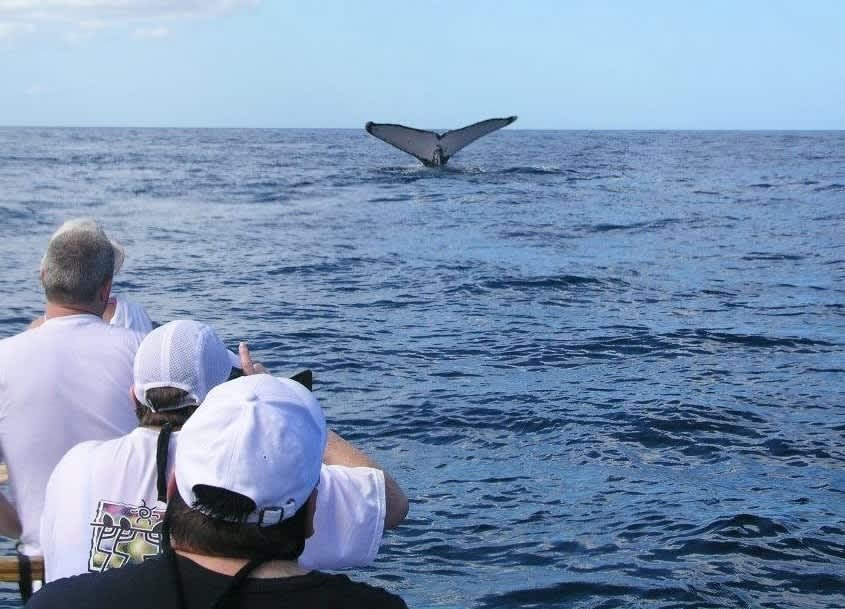 Whale Watching in Maui
Whale watching in Maui delivers a full catalog of humpback behaviors that marine researchers spend careers studying. Here's what to watch for:
Breaching — The full-body launch. A 40-ton whale clearing the water entirely and crashing back down. Often repeated 10–20 times in sequence. The most dramatic behavior you can witness in the ocean.
Pec slapping — The whale rolls sideways and repeatedly slaps a 15-foot pectoral fin on the surface. Thought to be a form of communication or thermoregulation.
Tail lobbing (lobtailing) — The tail raises and slaps the surface with explosive, audible force. You can hear this from remarkable distances.
Spy hopping — The whale rises vertically, head clear of the water, appearing to scan its surroundings. One of the stranger and more mesmerizing behaviors to witness.
Singing — Male humpbacks produce complex, evolving songs throughout the season. Hydrophones on whale watching tours in Maui let you hear them live underwater, which is an experience entirely unto itself.
Mother-calf pairs — Calves born in Maui's waters practice surfacing beside their mothers, typically rising every 3–5 minutes. Watching a newborn whale take its early surface breaths is the kind of moment that stays with people for decades.
With dozens of operators offering whale watching tours in Maui, quality varies considerably. Use this checklist when evaluating your options:
NOAA-permitted naturalist onboard (not just a captain)
Vessel carries a hydrophone for live underwater listening
Small group sizes especially essential for maui kayak whale watching
Whale sighting guarantee or credit policy
Reviews that specifically mention whale encounters, not just general boat conditions
Morning departures (calmer seas, typically more active whales)
For kayak whale watching specifically, confirm your guides are ocean safety certified and conduct a pre-launch safety briefing. South Maui operators frequently offer combo packages that pair whale watching with snorkeling at Molokini Crater an efficient way to maximize your time on the water.
Book early. Peak season whale watching tours in Maui fill weeks in advance. January weekends are the hardest dates to secure.
Dress in layers. Early morning ocean air is cooler than you'd expect, even in January.
Bring polarized sunglasses. They cut surface glare dramatically and help you spot spouts on the horizon before your guide does.
Prepare for motion. Even calm channel days have a gentle roll. Non-drowsy motion sickness remedies are widely available and worth taking preventively.
Shoot video, not just photos. A breach lasts 3–5 seconds. Continuous video captures what a single shutter click almost always misses.
Humpback whales were hunted to near-extinction in the 20th century. Their recovery is one of marine conservation's genuine success stories and responsible whale watching in Maui has contributed to it by building a community of advocates who care about these animals and the ecosystem that sustains them.
When you book with certified operators who follow NOAA approach guidelines, you're supporting an industry that funds whale research, opposes harmful shipping practices, and educates thousands of visitors annually on why these animals matter. The best whale watching tours in Maui don't just show you whales they give you a reason to protect them.
Unequivocally, yes. Whale watching in Maui is one of those rare travel experiences where reality genuinely exceeds expectation. The sheer scale of these animals, the frequency of sightings, and the emotional weight of watching a newborn calf take its first breath at the surface these are the kinds of experiences that reframe how you think about the natural world.
Whether you choose a fully-equipped catamaran with hydrophones and naturalist commentary, or the quiet intimacy of maui kayak whale watching, you're stepping into something both joyful and significant. The whales are here. The season is finite. Book before the best dates disappear.
How long is whale watching season in Maui?The season runs November through May, with peak activity from January through March when humpback concentrations are highest.
Is kayak whale watching in Maui safe?Yes, when conducted with certified guides who follow NOAA's 100-yard approach guidelines. Reputable maui kayak whale watching operators are trained to read whale behavior and keep groups at safe, respectful distances.
What's the best area of Maui for whale watching?South and West Maui Kihei, Makena, Maalaea, and Lahaina — offer the most reliable access to whale-rich waters. Most whale watching tours in Maui depart from these areas.
Can you see whales from shore in Maui?Yes. McGregor Point and Papawai Point on the Pali Highway are renowned shore-based lookouts. However, for close, immersive encounters, whale watching in Maui from a boat or kayak is significantly more rewarding than any shoreline view.